
PDF · free download, no form
Want the next one?
Optional. The download above never asks for your email.
Get the OT briefing
By subscribing, you agree to receive the OT briefing by email from Hillstrong Group Security, Atlanta, GA. Unsubscribe at any time with the link in every email. See our privacy policy.
white paper
Cybersecurity: A Pillar of Operational Resilience
The Role of Governance in Implementing and Sustaining Robust OT Security Programs
Chuck Tommey, P.E. , Co-Founder and Chief Advisory Officer · · Updated
OT resilience is the ability to keep essential plant functions during and after a cyber incident. Governance is who is allowed to make that call, against which risk, with which evidence. Tools do not make it. A RACI, a BIA that treats IT and OT as different failure modes, and a tested escalation path do.
Colonial Pipeline in May 2021 is the US case. DarkSide hit IT. OT was shut as a precaution because the governance framework did not say how to run the pipeline while IT was down. Fuel shortages followed. Decide the IT-hit / OT-up call before the incident. Segmentation without that call still stops the line.
What the working stack says
NIST CSF 2.0 Govern. Oversight, policy, and accountability as a function, not a preface. Cross-functional review of controls belongs in the operating rhythm.
ISO 27001. ISMS: policy, roles, internal audit, management review. Useful for the corporate loop. It will not, by itself, write the OT shutdown protocol.
IEC 62443. Roles and security policy across the IACS lifecycle, from design through operation. 62443-3-2 is the risk-assessment and zone-design clause plants can run.
NIST SP 800-82r3. ICS-specific incident response, playbooks, and recovery tied to operational objectives. This is the document to put in the IR team’s hands.
CMMI. A maturity lens on process discipline. Use it to score whether governance is a binder or a habit.
Table 1 in the full paper below compares those five on governance, risk, policy, metrics, leadership, and incident response. Steal the table. Do not flatten them into one “framework program.”
Two incidents, same gap
Colonial Pipeline (2021). No predefined IT-hit / OT-up protocol. Weak BIA on IT-OT interaction. Leadership decisions lagged because the decision rights were not on paper. Result: a full operational shutdown that the payload did not require.
Ukraine grid (2015 and 2016). Spear-phish into IT, then SCADA. About 225,000 customers in 2015. Attackers present for months. 2016 used Industroyer against grid stability. Failures: coordinated IT/OT response, detection, audits that would have caught access-control gaps, and communication that lets operators switch to manual without a committee.
What to install
-
A governance structure that names IT, OT, safety, and the executive who can keep the plant up. OT governance operationalization is that work.
-
Continuous risk ranking so compensating controls and exceptions have an owner. IEC 62443-3-2 is the method.
-
Incident-response governance you have exercised. OT incident response planning and simulation is the drill, not the binder.
-
Communication paths that survive the first hour. Write them. Then fail them in a tabletop.
If governance still dies at the department boundary, read OT governance has to cross security, engineering, operations, and safety.
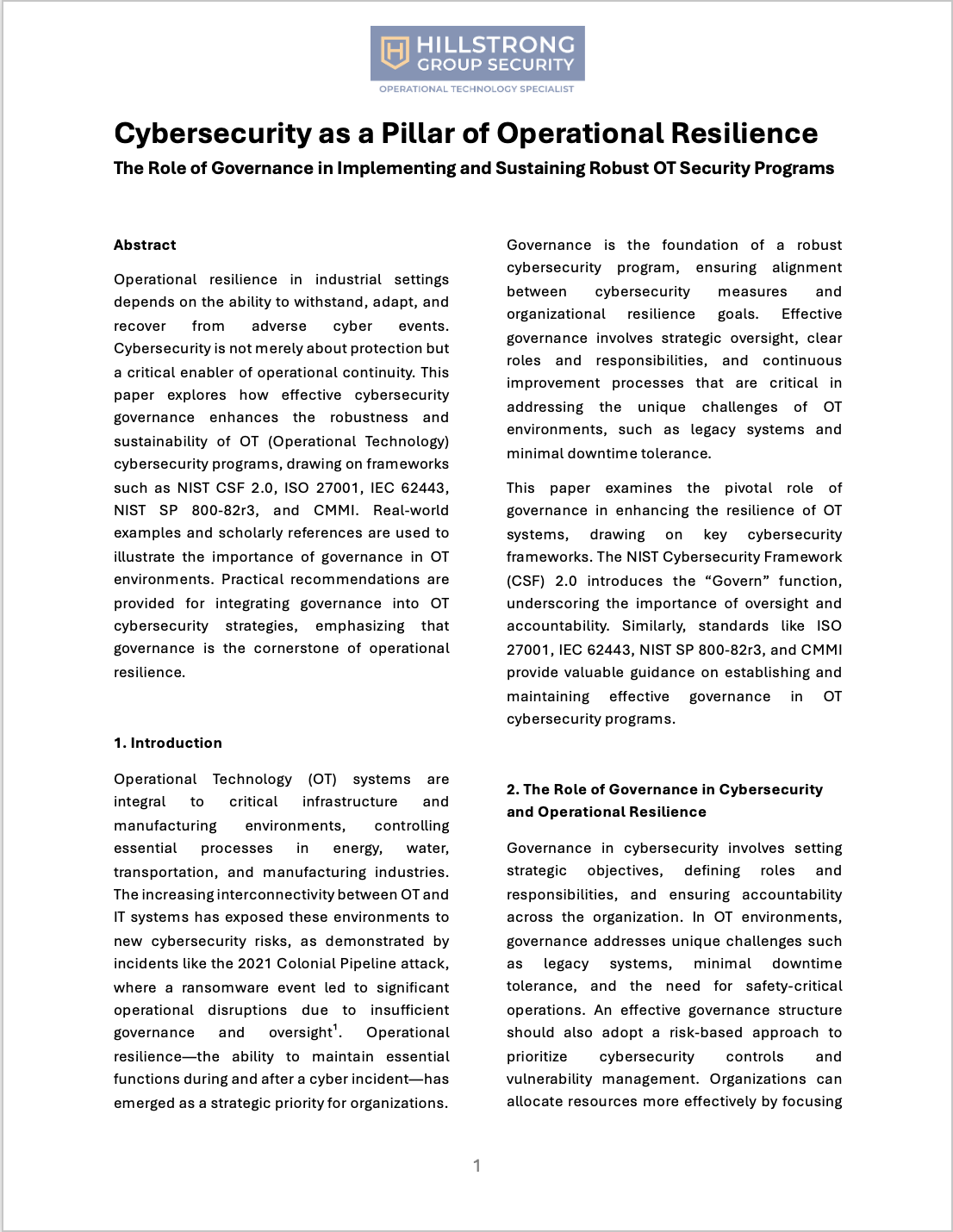
Chuck Tommey, P.E., wrote the paper in September 2024. The full text follows, including the framework comparison table and both incident write-ups. The PDF has the same content for download.
The full paper
Abstract
Operational resilience in industrial settings depends on the ability to withstand, adapt, and recover from adverse cyber events. Cybersecurity is not merely about protection but a critical enabler of operational continuity. This paper explores how effective cybersecurity governance enhances the robustness and sustainability of OT (Operational Technology) cybersecurity programs, drawing on frameworks such as NIST CSF 2.0, ISO 27001, IEC 62443, NIST SP 800-82r3, and CMMI. Real-world examples and scholarly references are used to illustrate the importance of governance in OT environments. Practical recommendations are provided for integrating governance into OT cybersecurity strategies, emphasizing that governance is the cornerstone of operational resilience.
1. Introduction
Operational Technology (OT) systems are integral to critical infrastructure and manufacturing environments, controlling essential processes in energy, water, transportation, and manufacturing industries. The increasing interconnectivity between OT and IT systems has exposed these environments to new cybersecurity risks, as demonstrated by incidents like the 2021 Colonial Pipeline attack, where a ransomware event led to significant operational disruptions due to insufficient governance and oversight¹. Operational resilience (the ability to maintain essential functions during and after a cyber incident) has emerged as a strategic priority for organizations.
Governance is the foundation of a robust cybersecurity program, ensuring alignment between cybersecurity measures and organizational resilience goals. Effective governance involves strategic oversight, clear roles and responsibilities, and continuous improvement processes that are critical in addressing the unique challenges of OT environments, such as legacy systems and minimal downtime tolerance.
This paper examines the pivotal role of governance in enhancing the resilience of OT systems, drawing on key cybersecurity frameworks. The NIST Cybersecurity Framework (CSF) 2.0 introduces the “Govern” function, underscoring the importance of oversight and accountability. Similarly, standards like ISO 27001, IEC 62443, NIST SP 800-82r3, and CMMI provide valuable guidance on establishing and maintaining effective governance in OT cybersecurity programs.
2. The Role of Governance in Cybersecurity and Operational Resilience
Governance in cybersecurity involves setting strategic objectives, defining roles and responsibilities, and ensuring accountability across the organization. In OT environments, governance addresses unique challenges such as legacy systems, minimal downtime tolerance, and the need for safety-critical operations. An effective governance structure should also adopt a risk-based approach to prioritize cybersecurity controls and vulnerability management. Organizations can allocate resources more effectively by focusing on the most critical assets and vulnerabilities, ensuring that the highest risks are addressed first. This approach is particularly important in OT environments, where downtime can have severe operational and safety consequences².
The following sections provide an overview of how different frameworks address governance.
2.1 NIST CSF 2.0 “Govern” Function
The NIST CSF 2.0 introduces the “Govern” function, emphasizing the need for robust governance to manage cybersecurity risks effectively. This function addresses governance structures, policies, and procedures that align cybersecurity efforts with business objectives, ensuring a coordinated approach to resilience³. For example, NIST CSF 2.0 highlights the importance of integrating governance into daily operations, such as regularly using cross-functional teams to review security controls.
2.2 ISO 27001
ISO 27001 provides a framework for establishing an Information Security Management System (ISMS), supporting governance by setting a structured approach to managing information security risks. It requires organizations to define security policies, roles, and oversight mechanisms that foster continuous improvement⁴. A manufacturing company, for instance, improved its OT cybersecurity by implementing ISO 27001, leading to better-defined security roles and regular security audits that uncovered vulnerabilities before they could be exploited.
2.3 IEC 62443
IEC 62443 focuses on industrial automation and control systems, emphasizing the need for defined roles, responsibilities, and security policies tailored to OT environments. It provides guidance on implementing governance practices that integrate cybersecurity throughout the system lifecycle, from design to operation⁵. An example from the energy sector illustrates how integrating IEC 62443 allowed for improved incident response protocols, reducing recovery time significantly after a cyber event.
2.4 NIST SP 800-82r3
NIST SP 800-82r3 offers recommendations specific to Industrial Control Systems (ICS), highlighting the importance of integrating cybersecurity governance with operational objectives. The guide emphasizes structured governance frameworks that facilitate coordinated incident response and recovery efforts⁶. This is crucial in OT environments, where downtime can have severe consequences, such as disruptions in power distribution networks.
2.5 CMMI for Cybersecurity
The Capability Maturity Model Integration (CMMI) provides a maturity model that organizations can use to assess and enhance their cybersecurity governance. It emphasizes process discipline, risk management, and continuous improvement of governance structures, making it particularly valuable for OT environments⁷. For example, a chemical processing plant used CMMI assessments to identify weaknesses in its governance processes, leading to enhanced policies and procedures that improved its overall security posture.
Table 1: Comparison of how pertinent cybersecurity standards cover governance and risk management topics.
| Category | ISO 27001 | NIST CSF 2.0 | NIST SP 800-82 | IEC 62443 | CMMI for Cybersecurity |
|---|---|---|---|---|---|
| Governance | Emphasizes a top-down approach with defined roles, responsibilities, and oversight. | Introduces the ‘Govern’ function to manage cybersecurity risk with accountability structures. | Focuses on structured governance frameworks tailored for Industrial Control Systems (ICS). | Requires governance across the full lifecycle of industrial control systems. | Focuses on governance maturity, highlighting disciplined processes and strategic oversight. |
| Risk Management | Central to the standard; involves risk assessments, risk treatment plans, and continuous risk evaluation. | Emphasizes risk-based decision-making, aligning risk management with organizational objectives. | Provides specific risk management recommendations for ICS, including risk assessments and mitigations. | Integrates risk assessments into all phases of system design and operation. | Uses a maturity model to guide risk management practices, emphasizing continuous improvement. |
| Policy Development | Requires development and maintenance of security policies, procedures, and control objectives. | Encourages policies tailored to the organization’s risk and resilience needs, aligned with the Govern function. | Focuses on policy development specific to control systems, ensuring alignment with operational needs. | Mandates tailored security policies for control systems, with guidance for different stakeholders. | Emphasizes policy creation as part of process discipline and improvement initiatives. |
| Reporting Metrics | Suggests regular reporting on ISMS performance, including risk treatment effectiveness and compliance. | Promotes the development of metrics to measure the effectiveness of cybersecurity practices. | Encourages performance measurement of incident response and risk management efforts in ICS. | Recommends tracking metrics for security performance and compliance across lifecycle phases. | Uses metrics to assess governance maturity and identify areas for process improvement. |
| Senior Leadership Engagement | Requires leadership commitment, including setting the policy, ensuring resources, and reviewing performance. | Emphasizes leadership involvement in risk management and governance oversight through the Govern function. | Highlights the importance of senior leadership in ICS governance, particularly in resource allocation. | Stresses leadership’s role in enforcing security measures and supporting governance structures. | Leadership engagement is critical, with a focus on driving continuous improvement and strategic alignment. |
| Incident Response | Requires establishing an incident response plan, testing, and continuous improvement based on incident reviews. | Emphasizes the need for coordinated response strategies aligned with governance and risk management. | Provides detailed guidance on ICS-specific incident response, including response teams and playbooks. | Focuses on response protocols tailored to control systems, including response coordination and testing. | Highlights the maturity of incident response processes and continuous improvement efforts. |
Real World Example #1: The 2021 Colonial Pipeline Incident, a Governance Failure in OT Cybersecurity
The 2021 Colonial Pipeline cyberattack stands as a stark example of how insufficient governance in OT cybersecurity can lead to significant operational disruptions. On May 7, 2021, the Colonial Pipeline Company, which operates one of the largest fuel pipelines in the United States, was targeted by a ransomware attack orchestrated by the cybercriminal group DarkSide. Approximately 17,000 gas stations reported fuel shortages, with some regions seeing up to 90% of gas stations out of fuel at the peak of the crisis¹⁵. The attack focused primarily on Colonial’s IT systems, encrypting data and demanding a ransom for its release. However, Colonial Pipeline’s response exposed critical governance shortcomings in its OT cybersecurity structure.
Key Governance Failures
- Lack of Clear Incident Response Protocols: The immediate decision to shut down OT operations was driven by uncertainty and lack of preparedness. Colonial Pipeline’s governance framework did not adequately define how to handle incidents where IT systems are compromised while OT systems remain unaffected. This lack of defined response procedures led to the precautionary shutdown of the entire pipeline, disrupting fuel supply across the Eastern United States.
- Inadequate Separation and Oversight Between IT and OT Systems: Although the attack targeted IT systems, poor governance and oversight meant there was no clear boundary or strategic management of the interaction between IT and OT systems. Effective governance structures, including Business Impact Analysis (BIA), would have ensured that OT operations had independent protections and alternate (non IT dependent) methods for tracking shipments, reducing the likelihood of a full operational shutdown in response to IT-specific threats.
- Insufficient Leadership Engagement and Decision-Making Frameworks: The governance gaps were evident in the response process, where decisions were delayed and reactive rather than proactive. Without robust leadership engagement and a clear governance structure, decisions were made due to an abundance of caution rather than through a predefined, risk-assessed approach. This lack of a strategic decision-making framework led to prolonged shutdowns, affecting millions of consumers.
- Failure to Integrate Risk Management into OT Governance: Effective governance requires continuous risk assessments and integration of risk management processes into OT systems. The Colonial Pipeline incident highlighted a disconnect between risk identification and operational resilience, as governance measures did not foresee the impact that an IT breach could have on OT systems. Regular risk assessments and better communication of risks between IT and OT teams would have helped mitigate the extent of the shutdown.
Impact of Governance Failures
The lack of clear governance structures directly contributed to the decision to halt pipeline operations, leading to widespread fuel shortages, price spikes, and public concern¹². This incident underscored the critical need for governance frameworks that clearly define roles, responsibilities, and incident response strategies specifically tailored to OT environments. It also demonstrated the importance of aligning OT cybersecurity governance with broader operational resilience goals to avoid cascading effects from cyber incidents that could otherwise be contained.
Lessons Learned
The Colonial Pipeline incident serves as a cautionary tale highlighting the need for robust OT cybersecurity governance. Key lessons include the importance of:
- Establishing distinct but collaborative governance structures for IT and OT systems.
- Defining clear incident response protocols that address the unique requirements of OT operations.
- Engaging leadership in the development and enforcement of governance policies.
- Continuously assessing and updating governance frameworks to adapt to evolving cyber threats.
Addressing these governance gaps can significantly enhance organizations’ operational resilience, ensuring that incidents affecting IT do not unnecessarily impact OT functions.
3. Building a Governance Framework for OT Cybersecurity
A robust governance framework integrates cybersecurity with organizational strategies, ensuring that resilience is prioritized at all levels. Key elements include defining roles and responsibilities, establishing clear policies, and implementing oversight mechanisms.
3.1 Defining Roles and Responsibilities
The NIST CSF 2.0 “Govern” function highlights the need for clearly defined roles and responsibilities, ensuring accountability in cybersecurity decision-making³. In practice, this could involve setting up cross-functional governance committees that include IT, OT, and business leaders to oversee cybersecurity efforts and ensure that decisions reflect both technical and operational considerations.
3.2 Policy Development and Oversight
ISO 27001 and IEC 62443 emphasize the importance of comprehensive policies that guide cybersecurity practices. Governance ensures these policies are regularly reviewed, updated, and enforced, maintaining alignment with evolving threats and operational needs⁴ ⁵. For example, periodic reviews of security policies at a pharmaceutical manufacturing company led to significant updates that strengthened their cybersecurity defenses against emerging threats.
Governance should drive the adoption of risk-based prioritization in control implementation and vulnerability management. For instance, ISO 27001 emphasizes the need to conduct regular risk assessments to identify critical vulnerabilities and prioritize remediation efforts accordingly. This risk-based approach ensures compliance and enhances resilience by focusing on controls that mitigate the most significant risks to operations⁸.
3.3 Performance Metrics and Continuous Improvement
Governance structures must include mechanisms for performance measurement and continuous improvement. CMMI’s maturity model can be leveraged to establish governance metrics, ensuring that processes are continually assessed and optimized⁷. A utility company, for instance, used maturity assessments to track its progress in cybersecurity governance, allowing for targeted improvements that enhanced its incident response capabilities.
Performance metrics should be aligned with a risk-based approach to ensure continuous improvement targets the most impactful areas. Organizations can leverage maturity models like CMMI to assess governance processes, using risk-based metrics to prioritize cybersecurity initiatives and measure their effectiveness over time. This approach supports continuous, targeted improvement in vulnerability management and control implementation⁹.
4. Incident Response Governance for Enhanced Resilience
Incident response is a critical component of operational resilience, and its effectiveness is directly linked to governance. Proper governance ensures that incident response teams are well-coordinated, roles are clearly defined, and response protocols are regularly tested.
4.1 Governance of Incident Response Teams
NIST SP 800-82r3 provides guidance on structuring incident response programs within OT environments. Governance plays a key role in defining incident response procedures, ensuring alignment with broader organizational resilience goals⁶. Effective incident response governance should incorporate risk-based decision-making to prioritize responses that protect the most critical assets. This ensures that incident response resources are focused where they can most effectively mitigate damage, especially in OT environments where certain systems may have higher operational risks¹⁰.
4.2 Accountability and Decision-Making
The NIST CSF 2.0 “Govern” function underscores the importance of governance in supporting timely decision-making during incidents³. Clear governance structures enable rapid escalation and resolution of incidents, minimizing their impact on operations. A case in point is how some energy companies have established clear incident escalation protocols that allow for immediate executive involvement when critical threats are detected.
Effective incident response governance should incorporate risk-based decision-making to prioritize responses that protect the most critical assets. This ensures that incident response resources are focused where they can most effectively mitigate damage, especially in OT environments where certain systems may have higher operational risks.
Real World Example #2: The 2015 and 2016 Attacks on the Ukrainian Power Grid, Governance Gaps in OT Cybersecurity
The unprecedented cyberattacks on Ukraine’s power grid in 2015 and 2016 highlighted severe governance failures in OT cybersecurity. These incidents marked the first known cyberattacks to successfully disrupt an electricity grid, demonstrating the devastating impact of inadequate cybersecurity governance in critical infrastructure. The attacks, attributed to Russian cyber threat actors, targeted Ukraine’s power distribution companies, causing widespread outages and highlighting the critical need for robust governance structures.
Key Governance Failures
- Lack of Coordinated Incident Response Protocols: During the 2015 attack, attackers gained access to IT and OT systems through spear-phishing campaigns, eventually taking control of SCADA systems to cut power to approximately 225,000 customers. The lack of predefined, coordinated incident response protocols between IT and OT teams meant that operators were unprepared to manage the attack as it unfolded. This gap allowed the attackers to manipulate circuit breakers and disconnect substations without timely intervention⁷.
- Inadequate Monitoring and Detection Capabilities: The attacks revealed significant deficiencies in governance structures related to monitoring and detection. In both the 2015 and 2016 attacks, threat actors maintained a presence in the networks for months without detection, highlighting poor governance regarding continuous monitoring and threat detection capabilities within OT environments⁹. Effective governance would have ensured robust monitoring protocols and faster detection of unauthorized access.
- Failure to Conduct Regular Governance Audits and Assessments: Governance in OT systems must include regular security audits and assessments to identify vulnerabilities and evaluate the effectiveness of existing controls. Ukrainian power companies lacked these critical governance processes, which allowed attackers to exploit known vulnerabilities without detection or remediation. Governance audits could have identified gaps in access controls and incident response readiness, potentially preventing the extent of the damage⁹.
- Insufficient Cross-Functional Communication and Decision-Making: The governance framework in place failed to promote effective communication between IT, OT, and leadership teams. During the attacks, poor communication and decision-making led to delays in response actions, such as switching systems to manual operation. Strong governance would have established clear communication channels and decision-making protocols to enable swift, coordinated actions during a crisis.
Impact of Governance Failures
The 2015 attack led to power outages lasting several hours, while the 2016 attack focused on disrupting grid stability through more sophisticated malware like Industroyer⁹. These incidents exposed the vulnerability of critical infrastructure to cyber threats, significantly impacting public trust and highlighting the severe consequences of inadequate governance in OT cybersecurity. The attacks not only caused immediate physical disruptions but also sent a strong geopolitical message about the vulnerabilities of critical national infrastructure.
Lessons Learned
The Ukrainian power grid attacks underscored the need for improved governance frameworks that integrate cybersecurity directly into the operational strategies of OT environments. Key takeaways include the importance of:
- Developing and enforcing coordinated incident response protocols that are regularly tested through simulations.
- Enhancing monitoring capabilities to detect and respond to unauthorized access swiftly.
- Instituting a risk-based vulnerability management program to ensure vulnerabilities are addressed proactively while balancing risk of exploitation with the operational risk of the remediation.
- Establishing clear communication pathways among IT, OT, and leadership to facilitate rapid decision-making during incidents and then test them via tabletop exercises.
By addressing these governance gaps, organizations in critical infrastructure sectors can significantly strengthen their resilience against similar cyber threats, ensuring that governance structures not only protect but also enable quick recovery from adverse cyber events.
5. Recommendations for Strengthening Governance in OT Cybersecurity
5.1 Establish a Governance Structure
Organizations should establish a governance framework that integrates cybersecurity with broader operational and business objectives. This includes defining roles, policies, and accountability mechanisms as outlined in the NIST CSF 2.0 and ISO 27001³ ⁴. For instance, a cross-departmental governance committee can help align cybersecurity efforts with business needs.
5.2 Implement Continuous Risk Management
Adopt continuous risk management practices as recommended by IEC 62443, ensuring that governance structures support ongoing assessment and mitigation of cybersecurity risks⁵. Continuous risk management requires prioritizing security controls and remediation efforts based on the risk they present to the organization. By adopting a risk-based approach, organizations can ensure that resources are directed towards mitigating the highest risks first, enhancing overall resilience and operational security¹¹.
5.3 Foster a Culture of Resilience through Leadership Engagement
Governance should actively involve senior leadership to foster a culture of resilience. CMMI’s focus on leadership engagement can guide organizations in aligning cybersecurity efforts with strategic priorities⁷. Leadership buy-in is crucial, as it ensures that cybersecurity is treated as a strategic concern rather than a purely technical one.
5.4 Enhance Incident Response Capabilities through Governance
Strengthen incident response governance by following NIST SP 800-82r3 guidelines, ensuring that incident response plans are well-integrated into overall governance structures⁶. This involves regular training exercises and audits of response procedures to ensure readiness.
6. Conclusion
Effective governance is critical to the sustainability and resilience of OT cybersecurity programs. By integrating governance principles from NIST CSF 2.0, ISO 27001, IEC 62443, NIST SP 800-82r3, and CMMI, organizations can build robust, adaptable cybersecurity frameworks that not only protect against threats but also ensure continued operational resilience. Implementing governance structures that are continuously assessed and improved will provide organizations with a competitive edge in safeguarding critical operations.
References
- Ranger, S. (2021). Colonial Pipeline attack: Everything you need to know about the ransomware attack. ZDNet. https://www.zdnet.com/article/colonial-pipeline-ransomware-attack-everything-you-need-to-know/
- CISA Risk Management for Critical Infrastructure Sectors. Cybersecurity and Infrastructure Security Agency.
- NIST Cybersecurity Framework 2.0, “Govern” Function. National Institute of Standards and Technology, 2024.
- ISO 27001:2022. International Organization for Standardization.
- IEC 62443. International Electrotechnical Commission.
- NIST SP 800-82r3. National Institute of Standards and Technology, 2023.
- CMMI for Cybersecurity. CMMI Institute.
- ISO 27005:2018 Information Security Risk Management. International Organization for Standardization.
- FAIR Institute. (2021). Factor Analysis of Information Risk (FAIR) Framework for Cybersecurity Risk Management.
- NIST SP 800-61 Rev. 2: Computer Security Incident Handling Guide. National Institute of Standards and Technology.
- IEC 62443-3-2: Security Risk Assessment and System Design for Industrial Automation and Control Systems. International Electrotechnical Commission.
- Egan, M. (2021-05-12 05:48 PM). Gas stations in the Southeast run out of gas as people panic buy fuel. CNN Business. https://www.cnn.com/2021/05/12/business/gas-shortage-colonial-pipeline/index.html
- Lee, R. M., Assante, M. J., & Conway, T. (2016). Analysis of the Cyber Attack on the Ukrainian Power Grid. SANS Industrial Control Systems Report. https://nsarchive.gwu.edu/sites/default/files/documents/3891751/SANS-and-Electricity-Information-Sharing-and.pdf
- Dragos. (2016). CRASHOVERRIDE: Analyzing the Malware that Attacks Power Grids. (2017-06-17) Dragos, Inc. https://www.dragos.com/resources/whitepaper/crashoverride-analyzing-the-malware-that-attacks-power-grids/
- Inside Edition Staff. Gas Shortage Continues Across Southeast in Aftermath of Cyberattack (2021). Inside Edition. https://www.insideedition.com/gas-shortage-continues-across-southeast-in-aftermath-of-cyberattack-66955