service · Advisory & Program
OT security governance implementation
Turn OT policy into site-owned work
Hillstrong gives each OT policy an owner, a site, and a close date, then collects the evidence as the work closes. The governance pack stays current.
how the engagement runs
- 01
Current State Assessment
Working sessions with IT security, OT engineering, operations, and the affected business domains. Existing governance artifacts inventoried against the operationalization model. Gaps named.
- 02
Management Structure Design
Executive sponsor, steering committee, and operational lead structure mapped to your org. An ownership model marks each document OT-only, IT-modified, or joint IT-OT, and the governance stack is laid out layer by layer.
- 03
Process Sequencing & IT-OT Integration
Four-layer stack populated layer by layer with NIST 800-82r3, CSF 2.0, and IEC 62443-2-1 traceability. Decision rights, risk acceptance, escalation, and reporting cadence built. Implementation sequenced in three stages: the groundwork before the charter is signed, a first working version, and full operation.
- 04
Operationalization & Handoff
Final RACI across business units, domains, and subsidiaries. Steering committee stood up. First review cycle run. Program handed to the operating owner with the documents that survive turnover.
who does the work
Led by senior OT practitioners
Engagement lead
Lead assessor
Security engineer and architect
Analyst

A risk exception comes up at a plant, and the site lead does not know who can approve it. The policies exist in draft and the tools are deployed, so the decision waits on whoever remembers how it went last time.
This service builds the operating model that makes governance run. We set who decides and how exceptions and incidents escalate, then define how IT and OT teams share work on the documents that touch both. We stand up the steering committee, run the first review cycle with you, and hand the program to its operating owner.
OT security program design writes the charter, policies, and RACI. This service starts once those documents exist and makes them run day to day. The OT leaders page shows where this work sits for the person who owns the program.
If you use Resilion, the RACI and review cadence live there, so each owner can see what is due.
after the engagement
The findings keep moving
Clients who want help running the fixes can put the findings in Resilion, the platform we use to run programs. Each fix gets a named owner at a named site, and the evidence lands as it closes.
See how Resilion works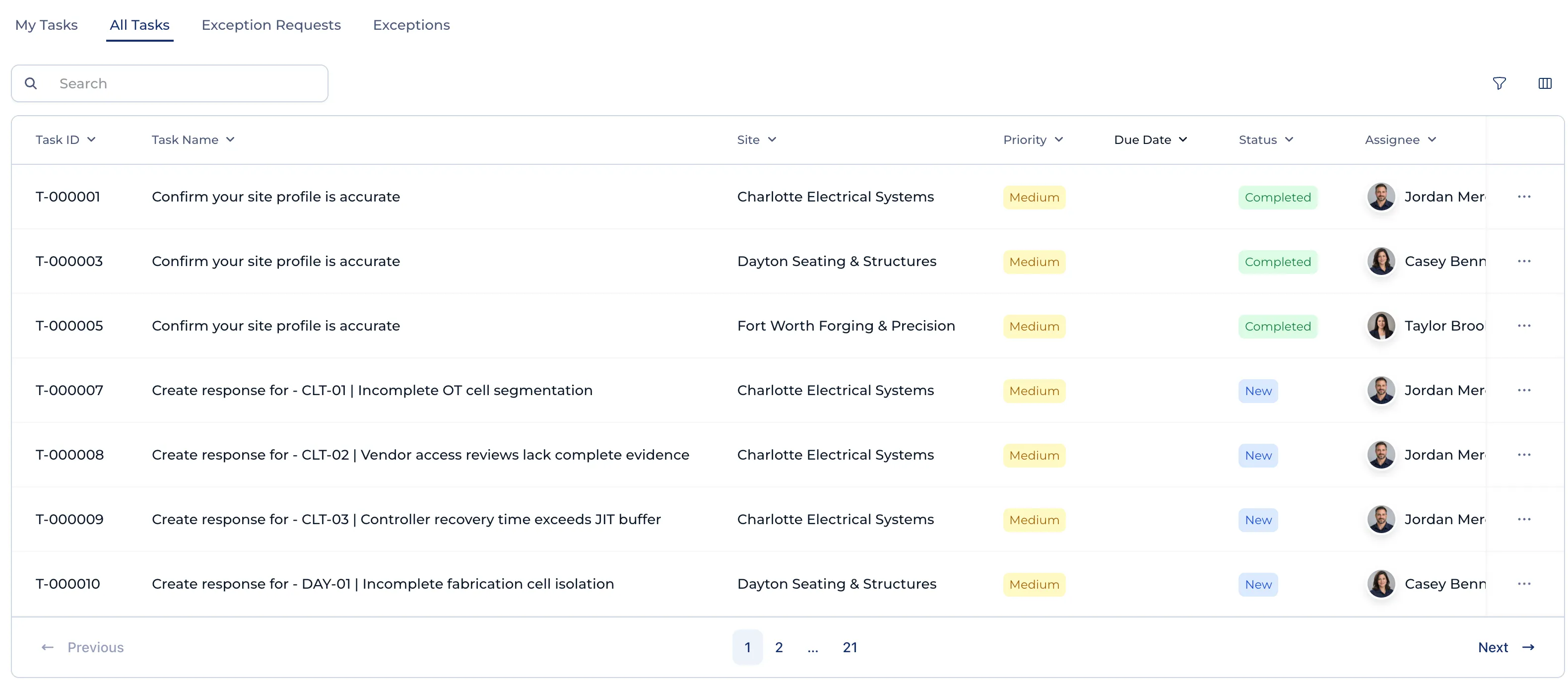
keep reading
Reading on this work
- OT Exceptions, Vendor Access, and Connectivity Expose Whether Governance Is RealA credible OT exception process names a risk owner, documents constraints and compensating controls, sets review dates, and escalates repeat patterns.Read the post →
- OT Governance Has to Cross Security, Engineering, Operations, and SafetyOT governance works when security, engineering, operations, safety, and risk decide together. Who belongs in the forum, and five failure modes to watch for.Read the post →
- Governance and Reporting That ScalesScale OT governance with live dashboards, tracked approvals, and cross-framework reports. One manufacturer cut board reporting from three weeks to half a day.Read the post →
FAQ
Questions about OT security governance implementation
- What does operationalizing governance mean?
- Turning written policy and org charts into a program that runs day to day, real decision rights, working escalation, defined RACI, meeting cadences, and IT/OT integration that functions as a working discipline.
- We already have policies. Why do we need this?
- Programs stall after the technology and policies are in place: decision rights are undocumented and escalation runs on tribal knowledge. This service closes the gap between the governance you wrote and the way the program operates.
Talk to the people who do this work
Thirty minutes with a senior OT security practitioner. We confirm fit, plant scope, and who should be in the room. If it is not a match, we say so.