service · Assessments
Plant OT risk assessment in three weeks
What a plant OT risk assessment should produce
IEC 62443-3-2 high-level assessment in three weeks. Zones, conduits, and the exposures worth funding this year, named in plant language.
how the engagement runs
About 3 weeks, with 1 to 2 days on site
- 01
Kickoff & Scope
Half-day session with plant leadership, operations, and engineering. Critical processes, recent incidents, and known concerns surfaced. Scope confined to the questions leadership needs answered.
- 02
Site Walk & Interviews
One to two days on site. Network, HMI, control room, and remote access reviewed with the controls engineer. Operators interviewed. No active scanning, no production disruption.
- 03
Risk Ranking
Top consequences and risk paths ranked under IEC 62443-3-2 risk framing. Each risk tied to specific impact on uptime, safety, quality, or regulatory exposure. Quick wins and longer plays separated.
- 04
Executive Brief
Concise report and executive presentation delivered. Top risks named in plant language. Three to five priority moves with effort and indicative cost. Path to a detailed assessment if appropriate.
who does the work
Led by senior OT practitioners
Engagement lead
Lead assessor
Security engineer and architect
Analyst

In about three weeks, with one to two days on site, this assessment shows plant leadership where the biggest cyber exposure sits and what to fund first.
We run the IEC 62443-3-2 high-level method against your site. We partition the system into zones and conduits, rate the risk to each, and surface the exposures that threaten production. On site, your controls engineer walks us through the network, HMIs, control room, and remote access, and we run no active scanning.
The executive brief names the top risks in plant language and gives three to five priority moves with effort and indicative cost. If you use Resilion, the findings land there as tasks.
When a move needs CapEx-grade depth, the detailed plant risk assessment models it zone by zone. The clause-level path for 2-1, 3-2, and 3-3 is IEC 62443 in practice.
after the engagement
The findings keep moving
Clients who want help running the fixes can put the findings in Resilion, the platform we use to run programs. Each fix gets a named owner at a named site, and the evidence lands as it closes.
See how Resilion works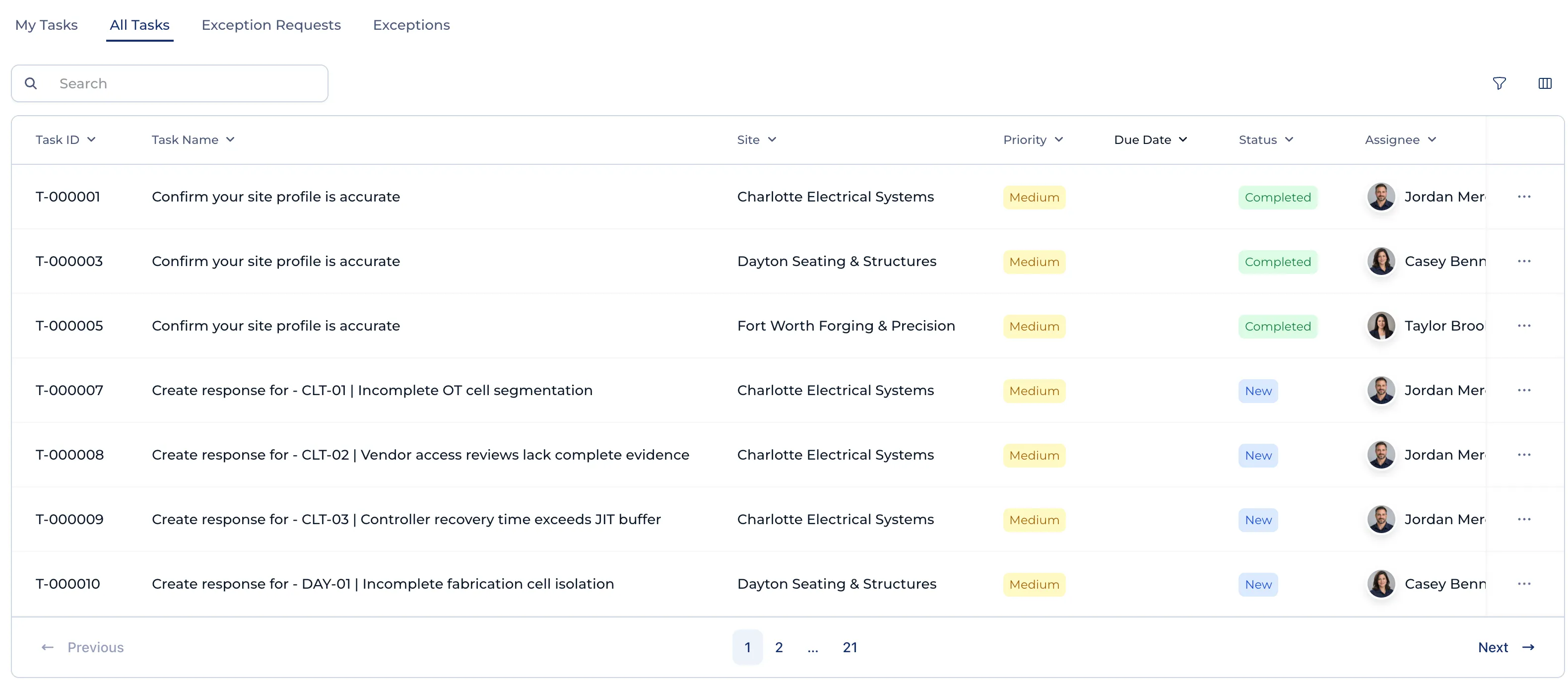
keep reading
Reading on this work
- 12 Plants, 12 Programs: Why Site-Level Risk Can’t ScaleSeparate OT security programs at each plant leave leaders unable to compare risk across sites. A tiered governance model with shared metrics fixes that.Read the post →
- The Enterprise Hat: When Cyber Risk Reaches the BoardroomHow NIS2 Article 20, SEC Item 1.05, and the SOCI Act moved cyber risk to the board, from turnover-based fines to management bans, and three moves to make.Read the post →
- What Is Operational Risk Costing You?The five cost categories of OT operational risk, from downtime to lost contracts, and a simple method to build a risk-adjusted exposure estimate in dollars.Read the post →
FAQ
Questions about Plant OT risk assessment in three weeks
- What is a high-level OT risk assessment?
- A rapid IEC 62443-3-2 partition of the plant into zones and conduits, scored for the highest-likelihood, highest-impact cyber risks to production, designed to give leadership a fundable starting point without a months-long engagement.
- How long does it take?
- About three weeks, versus three months for a full detailed assessment. It is scoped to answer where the biggest exposure sits and what to fund first.
- How long does an OT security assessment take and what does it cost?
- A plant high-level risk assessment takes about three weeks, with one to two days on site. A program maturity assessment takes about six weeks and runs remotely. A detailed plant risk assessment takes about three months. Cost follows the number of sites, the days on site, and the depth, so Hillstrong quotes each engagement after a 30-minute scoping call.
- How is it different from a detailed risk assessment?
- The high-level pass finds and prioritizes the exposure; the Plant Detailed Risk Assessment then models loss-of-view and loss-of-control scenarios zone by zone with the depth a CapEx decision needs.
Talk to the people who do this work
Thirty minutes with a senior OT security practitioner. We confirm fit, plant scope, and who should be in the room. If it is not a match, we say so.