service · Advisory & Program
OT security program design
Design an OT security program you can run
Charter, RACI, and site-tiered work from the assessments you already paid for. Hillstrong writes the program documents your plants will run on.
how the engagement runs
- 01
Program Diagnostic
Working sessions with IT security, OT engineering, operations, and compliance. Current state of charters, policies, and process documents inventoried. Gaps to IEC 62443-2-1 and NIST CSF 2.0 named.
- 02
Charter & Governance
OT cyber charter drafted with sponsor, scope, authority, and escalation. RACI matrix built across plant, region, and corporate. Decision rights agreed in writing.
- 03
Policy & Process Build
OT-specific policies for access, change, patching, incident, vendor, and segmentation. Procedures written for the people who execute them. Aligned to IEC 62443 and NIST 800-82r3, integrated with existing IT policies.
- 04
Rollout & Adoption
Executive briefing pack delivered. Pilot site selected for rollout. Adoption metrics defined. Quarterly maturity review cadence handed to the program owner.
who does the work
Led by senior OT practitioners
Engagement lead
Lead assessor
Security engineer and architect
Analyst

The first plant project succeeded on goodwill. The second ran the same playbook, and the third hit a wall. By then the policies live in three SharePoint sites, and new hires learn the program as folklore.
This service writes the charter, policies, RACI, and procedures a fleet-scale OT program needs, in language operators and auditors can both read. We name gaps against IEC 62443-2-1 and NIST CSF 2.0 and agree decision rights in writing across plant, region, and corporate. The executive sponsor signs the charter, and the rollout starts at a pilot site.
Program design produces the documents. When the documents already exist and the program still stalls on who decides, OT governance operationalization is the next step. If you have run a maturity assessment, its findings become the design brief.
If you use Resilion, the RACI and site work can live there once the program is written.
after the engagement
The findings keep moving
Clients who want help running the fixes can put the findings in Resilion, the platform we use to run programs. Each fix gets a named owner at a named site, and the evidence lands as it closes.
See how Resilion works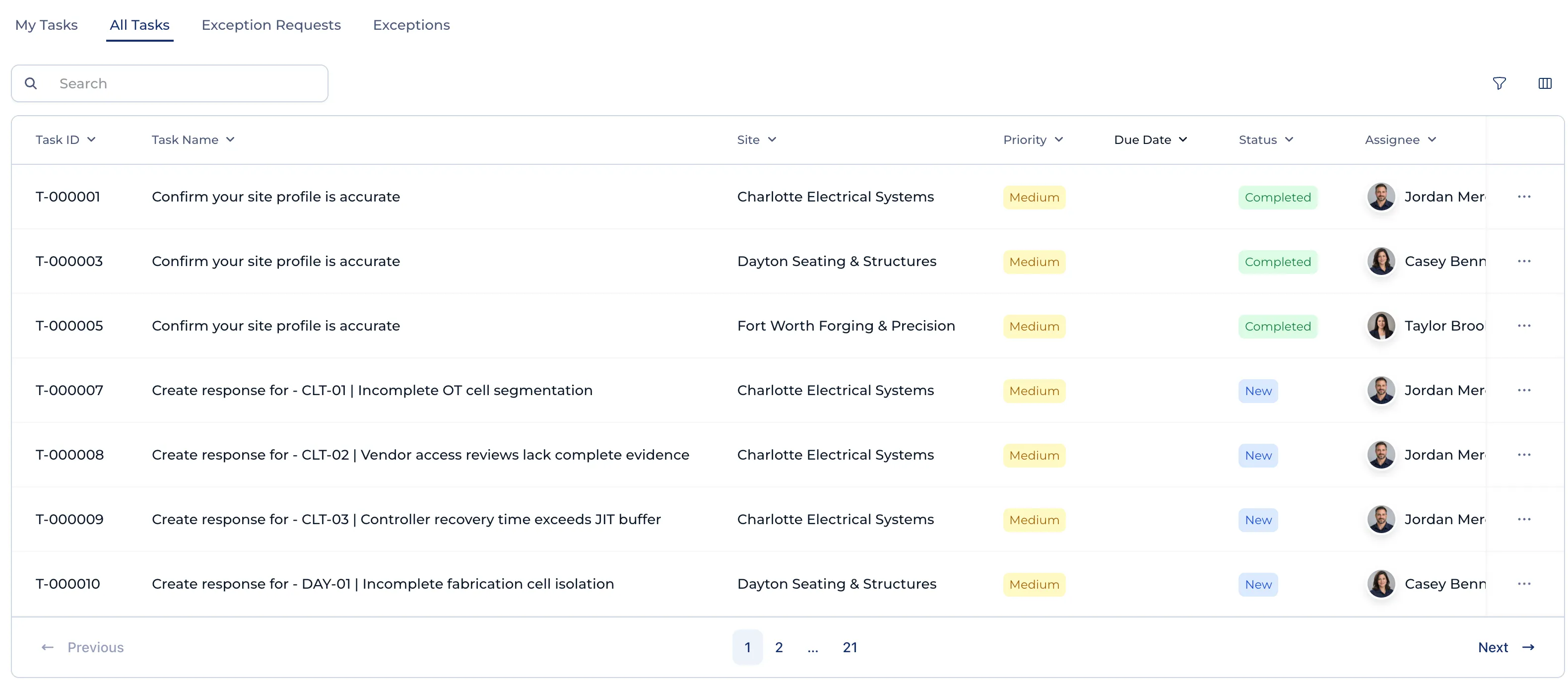
keep reading
Reading on this work
- A Useful OT RACI Starts With Decision Rights, Not DepartmentsA working OT RACI assigns five decisions: enterprise standards, site implementation plans, exception approval, incident authority, and vendor access.Read the post →
- OT Exceptions, Vendor Access, and Connectivity Expose Whether Governance Is RealA credible OT exception process names a risk owner, documents constraints and compensating controls, sets review dates, and escalates repeat patterns.Read the post →
- How Resilion Puts OT GRC Into Practice Across Your SitesResilion runs OT GRC in three pillars (Build, Execute, Manage) that produce IEC 62443 artifacts, site workflows, and audit evidence in days, not months.Read the post →
FAQ
Questions about OT security program design
- What does OT security program design deliver?
- The governance foundation: OT-specific policies and standards, defined decision rights and accountability, and a documented operating model that ties enterprise policy to what happens on the plant floor, the structure an auditor and a new hire can both follow.
- How is this different from writing policies?
- Policies without an operating model sit in draft. We design how the program runs, who decides, who executes, how exceptions and escalations flow, so governance runs as a working discipline.
Talk to the people who do this work
Thirty minutes with a senior OT security practitioner. We confirm fit, plant scope, and who should be in the room. If it is not a match, we say so.