
Operational Resilience Depends on IT and OT Working Together
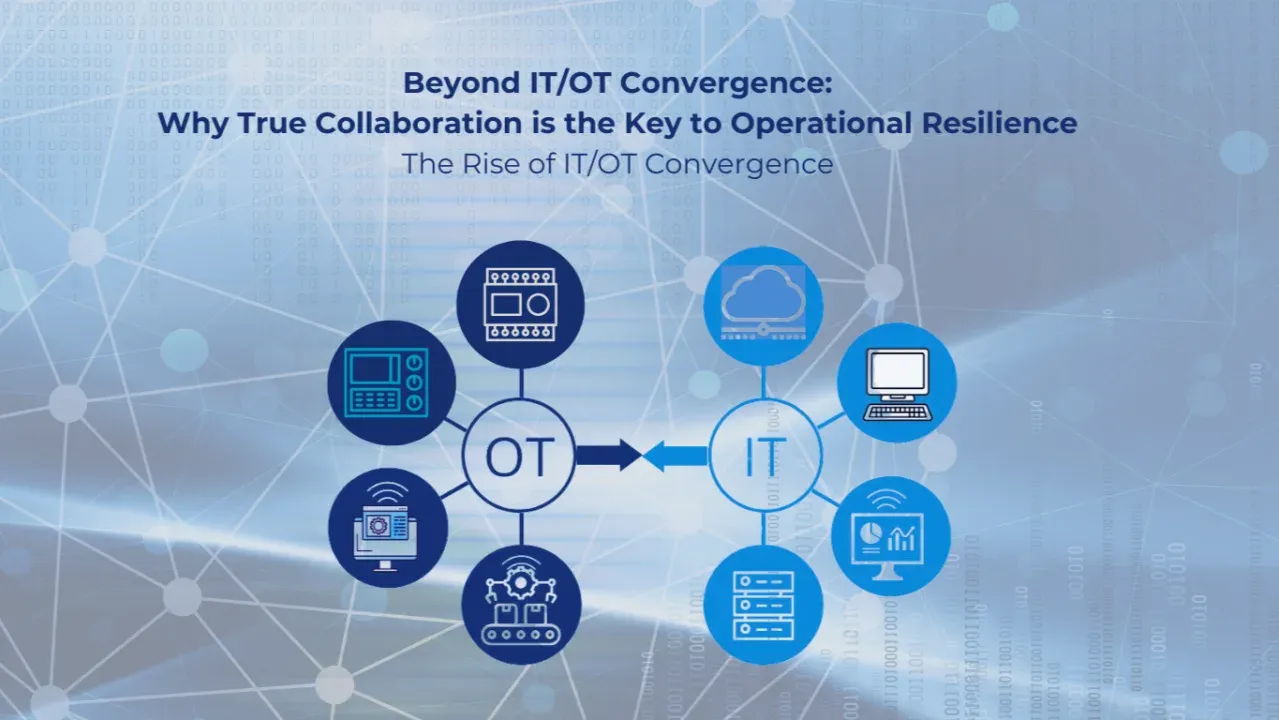
The Rise of IT/OT Convergence
Industrial companies are converging Information Technology (IT) and Operational Technology (OT) at a fast pace. The promise is integrated networks, cost savings, and simpler management. Convergence simplifies system integration and improves visibility, but it does not strengthen cybersecurity or operational resilience by itself. Without real collaboration, convergence can introduce new risks and leave the organization exposed.
OT cybersecurity has to be more than an add-on to IT security policy. Every cybersecurity initiative should advance the organization’s mission, whether that mission is delivering power, treating water, or keeping a manufacturing line running. A mission-focused, risk-based approach is the best way to test how an initiative will affect readiness. That approach depends on IT and OT teams working together, beyond the shared technology.
Why Convergence Alone Is Not Enough:
IT/OT convergence should bring real benefits, such as better data sharing, network visibility, fewer tools, and less training. It also creates security and collaboration problems that technology alone cannot solve:
-
Increased Attack Surface: More connected systems mean more entry points for attackers.
-
Cultural & Process Differences: IT and OT work under different priorities. IT values data confidentiality, while OT puts safety and uptime first.
-
Patching & Change Management Conflicts: IT enforces frequent updates. OT environments need stability and careful change control, often with regulatory implications.
-
Legacy System Security Gaps: Engineers designed many OT systems without cybersecurity in mind, and those systems are hard to upgrade.
These problems show why convergence is only the first step. The real work is building collaboration between IT and OT teams to address these risks in a way that keeps operations resilient.
What IT/OT Collaboration Looks Like:
IT and OT must build a cybersecurity strategy together that supports both security and business operations. Collaboration means:
-
Joint Risk Assessments: Both teams identify and prioritize security risks by operational impact. A plant high-level risk assessment is a practical place to start that work together.
-
Co-Designed Security Strategies: The teams tailor policies to OT environments instead of applying IT security measures unchanged.
-
Mutual Understanding & Respect: IT understands the constraints of OT, and OT recognizes why cybersecurity matters.
Without collaboration, plant staff may see IT-driven security initiatives as disruptive or unrealistic. OT’s focus on continuity may, in turn, leave cybersecurity risks unaddressed. Each side has to account for the other’s priorities.
Building a Secure and Resilient IT/OT Partnership:
1. Establishing an OT-Specific GRC Program
A Governance, Risk, and Compliance (GRC) program built for OT gives both teams a foundation for collaboration. Traditional IT GRC frameworks do not address OT requirements. That gap is why standards, frameworks, and maturity models like IEC 62443, NIST CSF 2.0, and CMMI matter.
An OT-specific GRC program:
-
Defines roles and responsibilities for IT and OT in cybersecurity.
-
Drives risk-based decisions that put safety and uptime first.
-
Sets compliance frameworks that meet regulatory and operational needs.
With a structured governance model, IT and OT teams can agree on security priorities without disrupting operations. Our OT security program design service builds that model with both teams in the room.
2. Developing a Joint Risk Management Strategy
Teams should assess cybersecurity risk by its effect on operations. Instead of treating all vulnerabilities the same, IT and OT should work together to:
-
Identify mission-critical systems and prioritize protections for them.
-
Put compensating controls in place when security patches are not feasible.
-
Add layered security controls that reduce risk without causing downtime and offer quick, non-disruptive mitigation.
-
Look for indirect dependencies of OT processes on IT or other business functions.
3. Aligning Cybersecurity with the Organization’s Mission
Cybersecurity should support operational resilience instead of standing in its way. To keep security initiatives tied to the organization’s mission, IT and OT must:
-
Build cybersecurity into business continuity planning.
-
Make sure security measures support uptime and productivity.
-
Use cybersecurity frameworks (IEC 62443, NIST CSF 2.0) to tie security to operational goals.
When teams judge security by whether the mission succeeds, IT and OT are more likely to work together well.
4. Strengthening Incident Response Collaboration
IT and OT must align before a cyber incident occurs. Good incident response planning includes:
-
Defining IT/OT-specific response protocols.
-
Running joint tabletop exercises and simulations.
-
Setting clear communication paths between IT and OT teams.
Teams that prepare together respond to threats faster and keep the impact on operations small. OT incident response planning and simulation gives both teams that practice before a real event.
Convergence Is Only the Beginning
IT/OT convergence is an important step toward modernizing industrial environments, but it does not solve cybersecurity by itself. Organizations must build deep collaboration between IT and OT to improve security and operational resilience.
-
Technology alone cannot solve IT/OT security problems. The teams have to collaborate.
-
An OT-specific GRC program gives IT and OT a foundation for a working relationship.
-
Every cybersecurity initiative must support the organization’s mission.
Organizations that move past convergence and invest in IT/OT collaboration can build a cybersecurity strategy that strengthens both security and operational resilience.