service · Assessments
RiskSpan IT/OT boundary assessment
Where IT/OT boundary risk sits this week
Passive capture of real IT/OT traffic for two to four weeks. Modbus, EtherNet/IP, OPC UA, and S7. Findings ranked by what they put at risk in production.
how the engagement runs
- 01
Data Collection
Passive sensors placed at IT/OT boundaries. Firewall logs exported. SPAN ports on core switches monitored for two to four weeks. No taps in production paths, no active probing.
- 02
Automated Analysis
Traffic flows decoded across Modbus, EtherNet/IP, OPC UA, S7, and proprietary stacks. Communication paths mapped. Anomalies, unauthorized communication, and misconfigurations surfaced for review.
- 03
Business Service Workshops
Cross-functional sessions with operations, engineering, IT, and business leaders. Boundary flows mapped to business services. Indirect threat paths from ERP, MES, and HR systems traced into OT impact.
- 04
QUICK Ranking & Roadmap
Findings ranked under the QUICK framework against quality, uptime, information integrity, compliance, and key deliverables. Costed remediation roadmap and executive briefing pack delivered.
who does the work
Led by senior OT practitioners
Engagement lead
Lead assessor
Security engineer and architect
Analyst

A firewall ruleset review reads the rules. It never sees what crosses the IT/OT boundary at 1400 on a Tuesday, and indirect threats from ERP, MES, and HR systems go unscored.
RiskSpan runs the assessment on real traffic. Passive sensors and exported firewall logs capture two to four weeks of boundary activity with no taps in production paths and no active probing. We decode flows across Modbus, EtherNet/IP, OPC UA, S7, and proprietary stacks. In workshops with your teams, we map those flows to business services and trace indirect threat paths into OT impact.
We rank every finding under QUICK, our framework for plant impact: quality, uptime, information integrity, compliance, and key deliverables. Leadership gets a costed roadmap that starts with what threatens production.
For the ruleset itself, firewall policy and log analysis works rule by rule. To keep watching the same boundary after the assessment, ConvergeWatch provides 24/7 monitoring.
after the engagement
The findings keep moving
Clients who want help running the fixes can put the findings in Resilion, the platform we use to run programs. Each fix gets a named owner at a named site, and the evidence lands as it closes.
See how Resilion works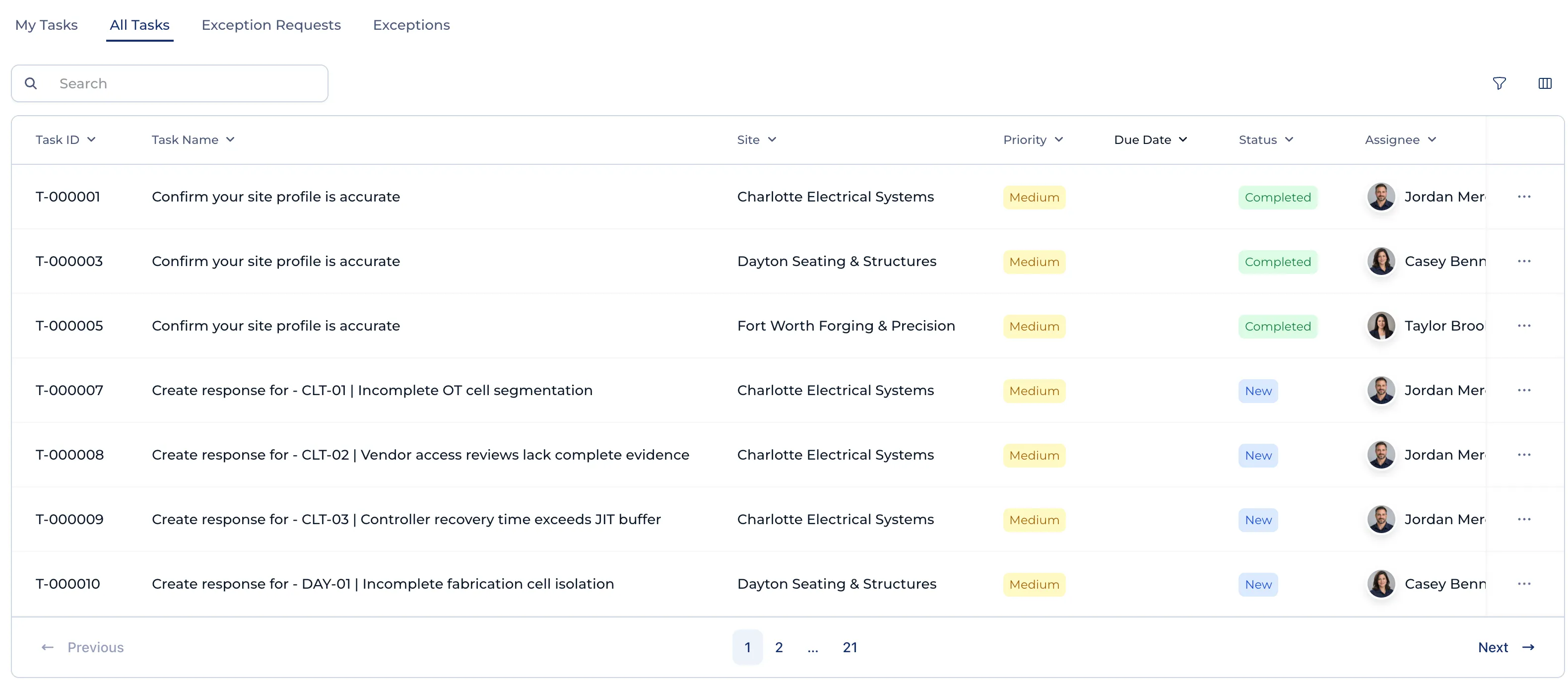
keep reading
Reading on this work
- How to Communicate OT Risk and Compliance to the BoardBoards fund OT security when audit findings read as business risk. Put a dollar figure on inaction, rank fixes by impact, and shape the message for CFO and CEO.Read the post →
- The OT Risk the CFO Can’t SeeWhy patch counts and scan stats fail at the executive table, how one contractor credential caused a $3.1 million outage across four sites, and what to report.Read the post →
- Jump Boxes and Workarounds Become Risk Nobody OwnsImprovised OT controls like jump boxes and ad hoc segmentation turn into risk nobody owns. Four steps bring them back: inventory, tier, assign, and retire.Read the post →
FAQ
Questions about RiskSpan IT/OT boundary assessment
- What is RiskSpan?
- RiskSpan is Hillstrong’s IT/OT boundary risk assessment run on real traffic. Passive sensors and firewall logs capture what crosses the boundary over two to four weeks; flows are decoded and mapped to business services, and findings are ranked under the QUICK framework (quality, uptime, information integrity, compliance, and key deliverables).
- Is it safe to run in production?
- Yes. RiskSpan is fully passive, sensors sit on SPAN ports and firewall log exports, with no taps in production paths and no active probing.
- How is it different from a firewall ruleset review?
- A ruleset review is theoretical; it never captures what crosses the boundary at 1400 on a Tuesday. RiskSpan measures real communication, surfaces indirect threats from ERP, MES, and HR systems, and ties each to the operation it puts at risk.
Talk to the people who do this work
Thirty minutes with a senior OT security practitioner. We confirm fit, plant scope, and who should be in the room. If it is not a match, we say so.