service · Assessments
Detailed OT plant risk assessment
Rank plant work zone by zone under IEC 62443-3-2
Zone-by-zone IEC 62443-3-2 detail for loss of view and loss of control. Ranked work a CapEx decision can use, with a costed roadmap.
how the engagement runs
- 01
Scope & Consequence Workshop
Working sessions with operations, engineering, and safety leadership. Process groups, the functions the plant cannot lose, and unacceptable consequences agreed. Zones and conduits drafted under IEC 62443-3-2.
- 02
Technical Walk-Down
On-site review of network architecture, controllers, HMIs, engineering workstations, and remote access paths. Passive collection. Configurations and dataflows documented from production as it runs.
- 03
Threat Modeling & Gap Analysis
Loss-of-view and loss-of-control scenarios modeled against MITRE ATT&CK for ICS tradecraft. Controls scored against IEC 62443-3-3 and NIST 800-82r3. Each gap weighted by consequence and adversary feasibility under NIST 800-30.
- 04
Roadmap & Briefing
Costed remediation roadmap sequenced for immediate, mid-term, and long-term action. Aligned to outage windows and CapEx cycles. Executive briefing pack delivered to plant and corporate leadership.
who does the work
Led by senior OT practitioners
Engagement lead
Lead assessor
Security engineer and architect
Analyst

A detailed assessment runs the full IEC 62443-3-2 method, zone by zone and conduit by conduit. A PLC with a CVSS-9 that cannot be reached from the boundary may matter less than a CVSS-5 on a controller that runs a safety-critical line, so we rank by production impact.
We start with operations, engineering, and safety leadership to agree process groups, the functions the plant cannot lose, and the consequences the plant will not accept. Our team walks the site and documents configurations and dataflows from production as it runs. Then we model loss-of-view and loss-of-control scenarios against MITRE ATT&CK for ICS and weight each gap by consequence and adversary feasibility under NIST 800-30.
The roadmap covers 12 to 24 months, is costed, and follows your outage windows and CapEx cycles. If you use Resilion, every finding lands there as a task.
Plants that need a faster first pass start with the three-week high-level risk assessment. The clause-level path for 3-2 and 3-3 is in IEC 62443 in practice.
after the engagement
The findings keep moving
Clients who want help running the fixes can put the findings in Resilion, the platform we use to run programs. Each fix gets a named owner at a named site, and the evidence lands as it closes.
See how Resilion works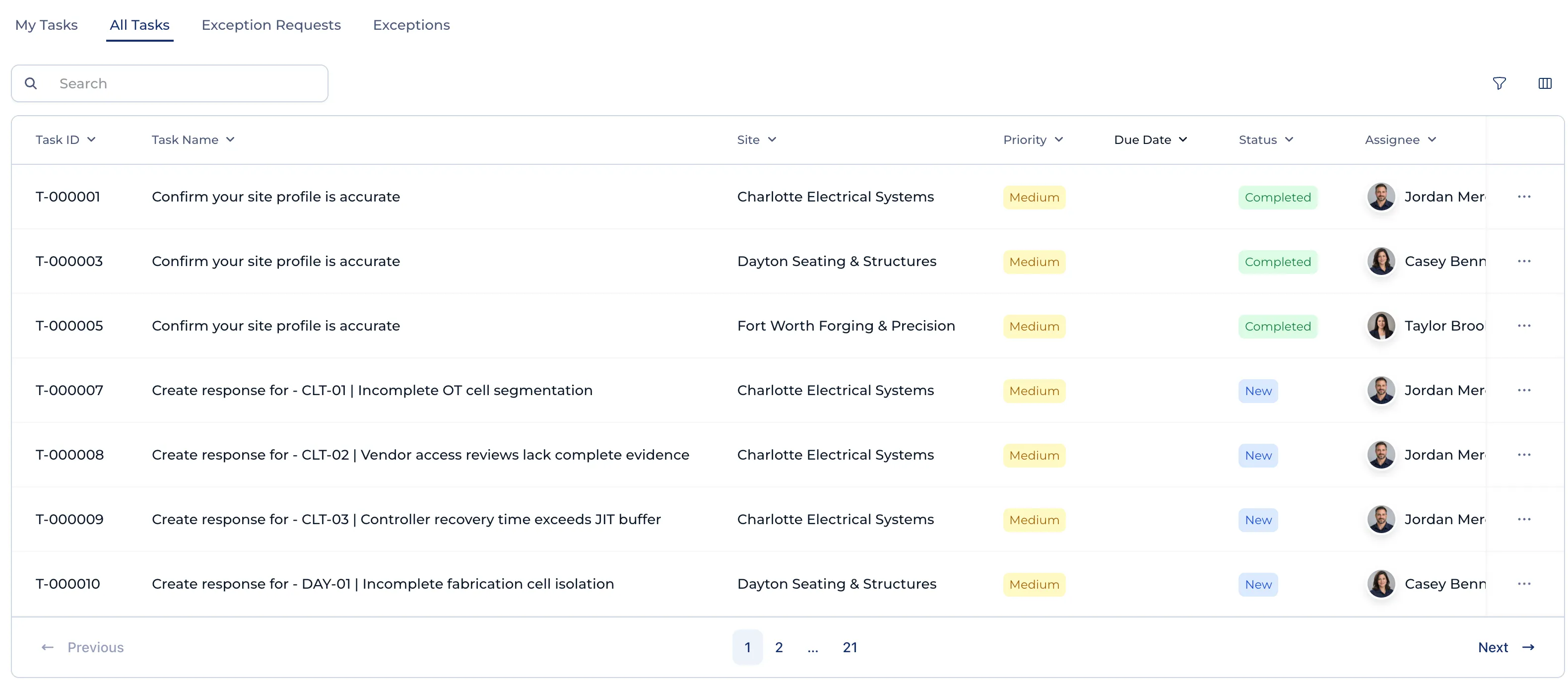
keep reading
Reading on this work
- Mapping OT Business Risk Using the QUICK FrameworkThe QUICK framework scores OT assets on Quality, Uptime, Information Integrity, Compliance, and Key Deliverables to rank vulnerabilities by business impact.Read the post →
- OT Framework Alignment with AIAI framework alignment maps one evidence set across IEC 62443, NIS2, SOCI, and NERC CIP. One energy company cut audit preparation time by 40% through reuse.Read the post →
- When Patching Won’t Protect Your FactoryWhy patch metrics miss most OT outages: in most disruptions Hillstrong reviewed, an operational failure caused the outage. Map dependencies instead.Read the post →
FAQ
Questions about Detailed OT plant risk assessment
- What does a detailed OT risk assessment cover?
- The full IEC 62443-3-2 detailed method: each zone and conduit assessed against realistic threat scenarios, with loss-of-view and loss-of-control consequences modeled, likelihood and impact scored, and countermeasures mapped to a costed roadmap.
- Why not just use CVSS scores?
- CVSS ranks vulnerabilities in the abstract. A PLC with a CVSS-9 that cannot be reached from the boundary may matter less than a CVSS-5 on a controller that runs a safety-critical line. We rank by production impact so remediation money goes where it changes risk.
- Will the output survive a CapEx review?
- Yes, that is the point. Findings are tied to business consequence and a sequenced, costed roadmap, so finance has a plan it can fund.
Talk to the people who do this work
Thirty minutes with a senior OT security practitioner. We confirm fit, plant scope, and who should be in the room. If it is not a match, we say so.