service · Advisory & Program
OT vulnerability management program
OT vulnerability management without a patching fantasy
Rank OT vulnerabilities by plant consequence, with compensating controls and change windows. A program your plants can run this year.
how the engagement runs
- 01
Current-State Assessment
Asset inventory review, scanner posture, patch history, and ICS-CERT advisory tracking evaluated. Existing procedures compared against IEC 62443-2-3 and NIST 800-82r3. Gaps and risk-weighted findings produced.
- 02
Risk-Based Prioritization
Vulnerability scoring tied to operational impact, exploitability under MITRE ATT&CK for ICS, and compensating controls. The 3 to 6 percent of vulns worth action this quarter named explicitly.
- 03
Program Design
Policies, procedures, RACI, and decision gates written. Patch windows aligned to outage cycles. Tool selection for OT-safe scanning, asset inventory, and advisory tracking. Integration with IT vuln management defined.
- 04
Rollout & Adoption
Pilot site selected. Training delivered to operations, engineering, and security. Quarterly review cadence handed to the program owner. Executive briefing pack delivered to the sponsor.
who does the work
Led by senior OT practitioners
Engagement lead
Lead assessor
Security engineer and architect
Analyst

A scanner runs across the IDMZ once a quarter and produces a thousand-line spreadsheet. The plants set it aside, because patching a PLC at 0200 is off the table, and the CVSS-9 list sits on the CISO’s desk.
This service builds a program the plant can live with. We prioritize by production impact and exploitability under MITRE ATT&CK for ICS, and we name the 3 to 6 percent of vulnerabilities worth action this quarter. Where a patch cannot go in, we define compensating controls. Patch windows follow your outage cycles.
The program needs an asset list first, and OT asset discovery builds one from passive evidence. The procedures follow IEC 62443-2-3, and IEC 62443 in practice covers that clause-level path.
A pilot site proves the program before it rolls out. If you use Resilion, each item is tracked there to closure.
after the engagement
The findings keep moving
Clients who want help running the fixes can put the findings in Resilion, the platform we use to run programs. Each fix gets a named owner at a named site, and the evidence lands as it closes.
See how Resilion works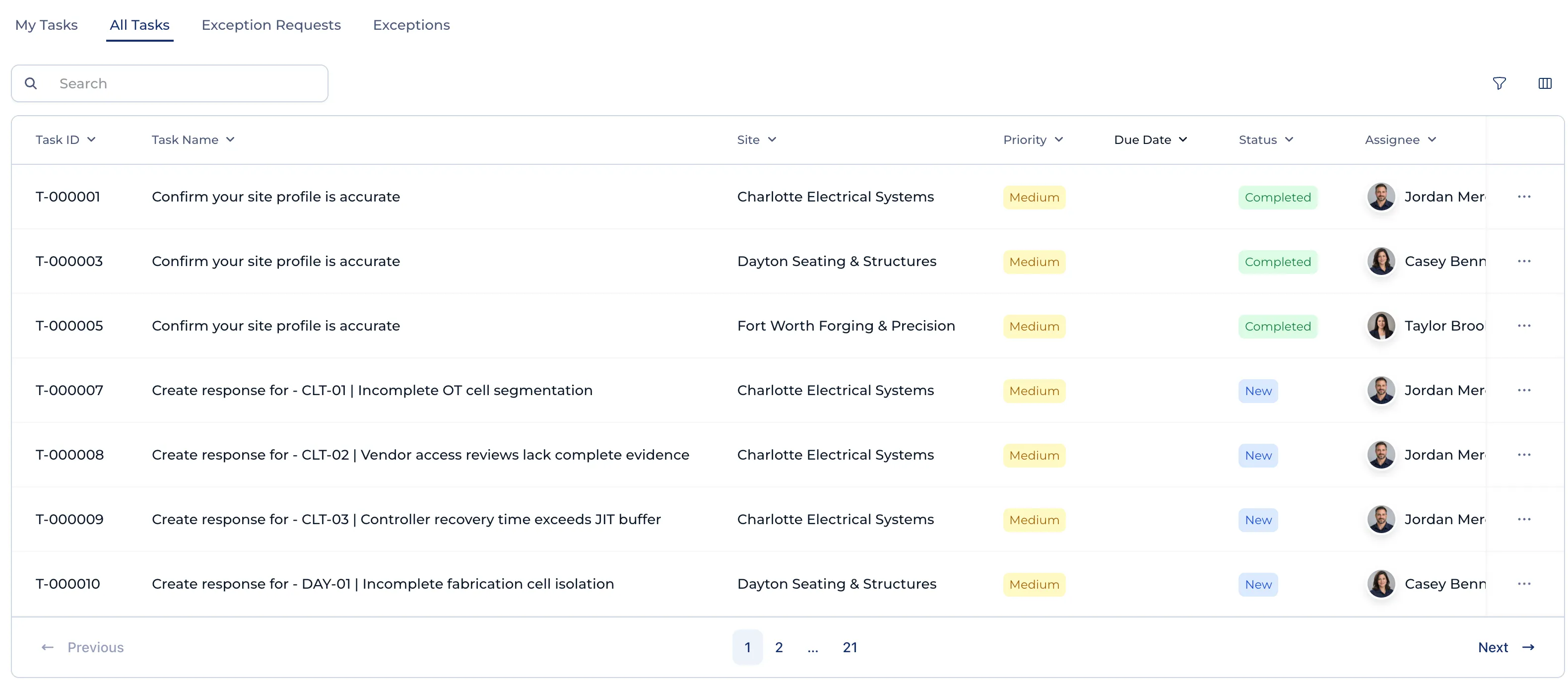
keep reading
Reading on this work
- How to Build a Sustainable OT Vulnerability Management ProgramA lasting OT vulnerability management program needs an OT-specific RACI, central governance with site flexibility, tracked exceptions, and a steady cadence.Read the post →
- When Patching Won’t Protect Your FactoryWhy patch metrics miss most OT outages: in most disruptions Hillstrong reviewed, an operational failure caused the outage. Map dependencies instead.Read the post →
- Why Patching is Not a Panacea in OT SecurityIT-style patching fails in OT. See how a pharma plant secured an FDA-validated system without a patch, and three metrics that beat patch compliance.Read the post →
FAQ
Questions about OT vulnerability management program
- How does OT vulnerability management differ from IT?
- You often cannot patch a PLC at 0200, so a CVSS-ranked spreadsheet is useless. An OT program prioritizes by production impact and exploitability in context, leans on compensating controls when patching is not feasible, and runs on a cadence operations can sustain.
- What do you build?
- The full program: asset and vulnerability sources, a prioritization model tied to plant impact, compensating-control playbooks, and a closure cadence. If you use Resilion, remediation items land there as tasks.
Talk to the people who do this work
Thirty minutes with a senior OT security practitioner. We confirm fit, plant scope, and who should be in the room. If it is not a match, we say so.