service · Resilience & Response
OT disaster recovery and BCP
OT disaster recovery that matches the plant
Restore paths, RTO, and who can take the plant down on purpose, written for the operations team that runs the recovery and proven in a live restore test.
how the engagement runs
- 01
Business Impact Analysis
Business impact analysis run against operations leaders. The functions the plant cannot lose are ranked by revenue loss per hour, safety exposure, and customer commitment. RTO and RPO set per function.
- 02
Asset & Dependency Mapping
PLCs, HMIs, historians, engineering workstations, network gear, and OEM dependencies inventoried. Recovery dependencies traced from the line back through control hierarchy and IT services.
- 03
DR & BCP Build
Backup, image, and configuration strategy designed against ransomware-grade threats. Manual operations fallback documented. Continuity playbook written for plant leadership.
- 04
Restore Test & Sign-Off
Live restore exercise on a representative system. RTO measured against the clock. Findings briefed to executive sponsor. Plan signed off by operations, engineering, and security.
who does the work
Led by senior OT practitioners
Engagement lead
Lead assessor
Security engineer and architect
Analyst

A PLC fails on a night shift, and the maintenance lead goes looking for its backup. The file exists. It has not been restored in two years, and the DR plan on the shelf sets RTO and RPO for the data center.
This service builds recovery around the plant. We run a business impact analysis with operations leaders and set RTO and RPO per production function. Then we design backup and restore sequencing against ransomware-grade threats and document manual operations fallback for plant leadership.
The engagement ends with a live restore on a representative system, timed against the clock. Operations, engineering, and security sign off the plan after that test.
This service writes and tests the full recovery plan. An OT ransomware readiness assessment measures whether the plant can recover today, and it is the faster place to start if you have not tested anything yet. The plan connects to your OT incident response runbooks, which name who isolates the plant before the restore begins.
after the engagement
The findings keep moving
Clients who want help running the fixes can put the findings in Resilion, the platform we use to run programs. Each fix gets a named owner at a named site, and the evidence lands as it closes.
See how Resilion works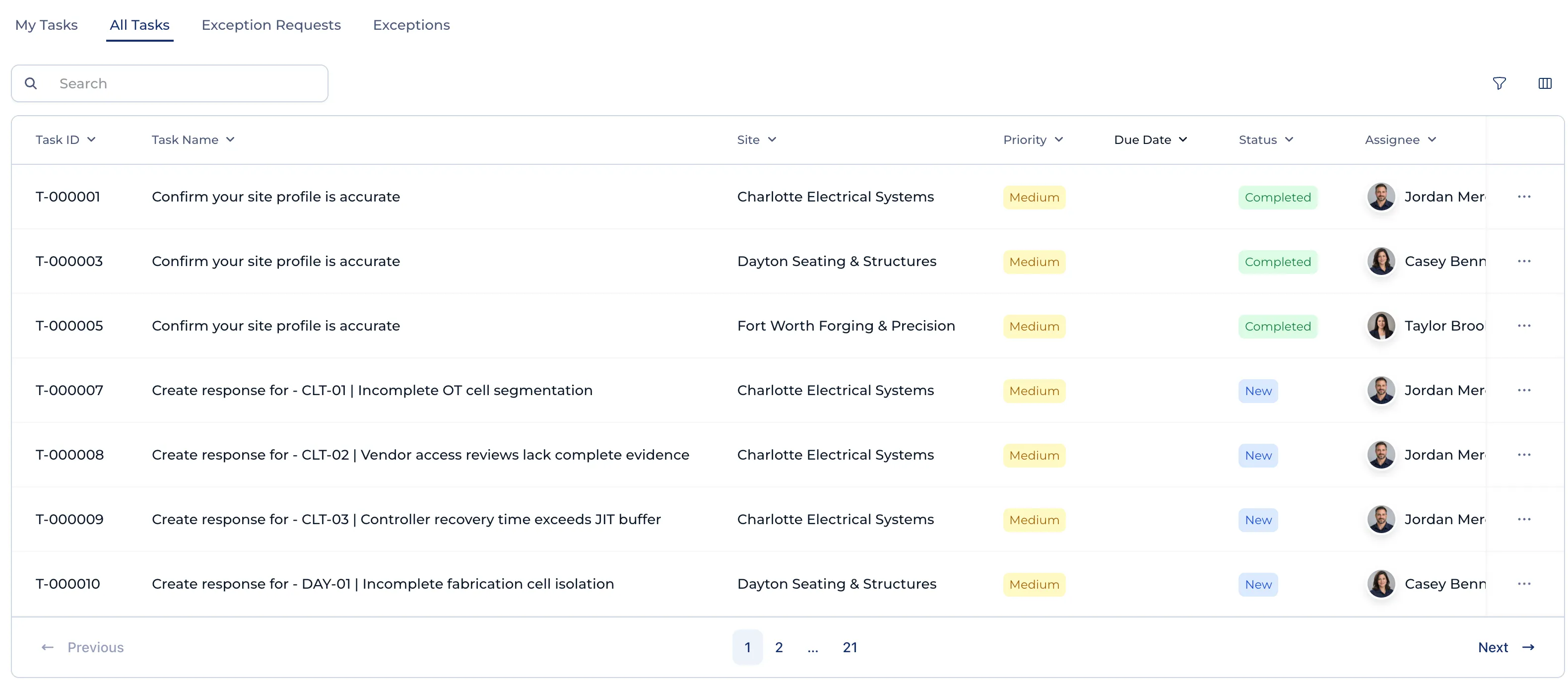
keep reading
Reading on this work
- Who Can Still Log Into Your Factory at 2:00 A.M.Why OT access reviews miss vendor paths like OEM tools, jump hosts, and cellular modems, how Akira bypassed MFA, and why every path needs an expiry date.Read the post →
- From Asset Inventories to Stop-the-Line MapsBuild a one-page stop-the-line map for each production line: six columns, a named owner per entry, and a restoration time measured with a stopwatch.Read the post →
- Your ERP Is a Plant Floor Control System – Nobody Scoped It That WayWhy ERP and SAP MII act as plant floor control systems, what Clorox's $49 million disclosure shows, and how to triage a 9.9 CVE that no patch window owns.Read the post →
FAQ
Questions about OT disaster recovery and BCP
- Why can’t we use our IT disaster recovery plan for OT?
- IT DR inherits RTO/RPO from the data center and assumes ERP is the critical path. On the plant floor the critical path is a controller, and a backup that has sat untested for two years proves nothing. OT DR/BC has to be built around production recovery and proven by test.
- What does the engagement produce?
- OT-specific recovery objectives, tested restore procedures for controllers and HMIs, and continuity plans built around the systems production cannot run without. If you use Resilion, the plan's actions land there as tasks.
Talk to the people who do this work
Thirty minutes with a senior OT security practitioner. We confirm fit, plant scope, and who should be in the room. If it is not a match, we say so.